
Transparent LCD Showcase Ambient Light Specification Guide: Contrast Ratio, Reflectance & Viewing Angle
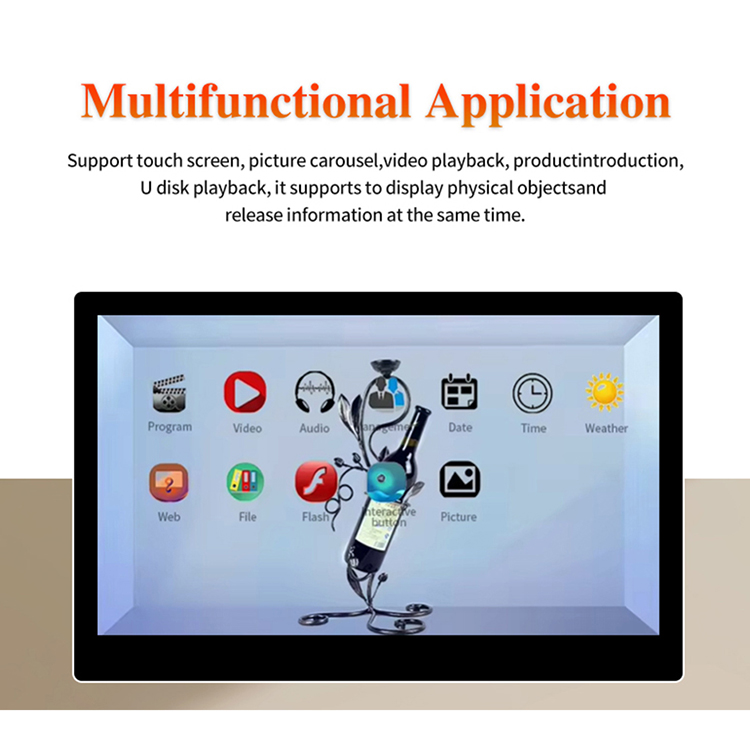
A transparent LCD showcase has to stay see-through while competing with storefront illumination — that tension, not the panel’s datasheet, decides whether your content is readable. Because a transparent LCD panel does not emit light on its own, it relies on a backlight and controlled enclosure lighting to render graphics, so ambient conditions govern real-world contrast ([6]). This guide translates the optics — ambient contrast ratio, reflectance, coating and bonding choices — into supplier-requestable spec values so a transparent LCD showcase ambient light specification survives the real installation site.
Why ambient light dominates transparent LCD spec decisions
Transparent LCD panels transmit only 20-30% of visible light, meaning the panel itself emits relatively little illumination and depends entirely on its backlight plus the lighting you build into the showcase enclosure ([3]). Higher transparency gives a cleaner view-through when idle, but it usually costs contrast once the display is lit. The core tension: your panel must remain optically see-through while side-by-side with bright storefront illumination — so the specification that matters is not raw brightness but the contrast you can achieve against the ambient light present at the fixture, not in a lab.
For product details and project planning, see Industrial Touch Monitor Selection Guide: Optical Bonding, Sunlight Readability & Wide-Temperature Design · Wintouch.
Ambient contrast ratio: the metric that matters more than brightness
Published panel contrast ratios of 1,000,000:1 are measured in the dark and say nothing about a sunlit storefront. Ambient contrast ratio, by contrast, measures usable contrast at the installation site, where the surrounding illumination adds to the panel’s surface reflection and washes out the image. Because reflected ambient light sits in the denominator of the ACR equation, the panels that rank best in marketing materials often perform worst in your showroom — ask suppliers for ACR under a stated ambient lux level, not a dark-room number ([1]).
Reflectance measurement: diffuse vs specular and anti-reflective coatings
| Reflectance type | Definition | What it affects | How to reduce it |
|---|---|---|---|
| Diffuse (hemispherical) | Reflected light scattered in all directions | Overall image haze and washed-out blacks under ambient light | Matte surface, lower-index cover glass |
| Specular | Mirror-like reflection from the front surface | Glare and mirroring of nearby light sources | Anti-reflective (AR) coating |
Panel suppliers typically report on-axis surface reflectance, which can understate what shoppers see from an angle. For high-ambient storefront sites, specify an on-axis surface reflectance of ≤1-2% with an AR coating, and ask for reflectance measured under your dominant ambient source. Reflections from surrounding ambient light sources are the primary load on ergonomic display performance, so reflectance control belongs in the spec — not just in marketing claims ([1]).
Transparency ratio and its impact on perceived contrast
See-through vs lit contrast is a direct trade — specify the balance your storefront needs before you buy.
The transparency ratio measures the share of visible light passing through the panel when off. For LCD, 20-30% is standard, and going above 35% usually forces compromises in colour and contrast ([3]). A higher-transparency panel reads clearer when idle but shows weaker, dimmer content when lit — because more light passes through rather than being modulated by the liquid crystals. Decide which state dominates your use case: a jewellery case mostly viewed dark, or a QSR window running sales content all day.
Viewing angle specification for storefront transparent displays
A datasheet value like 178°(H)/178°(V) is a nominal panel limit, not the angle at which content stays readable. Transparent LCDs are inherently sensitive to viewing angle because of the special arrangement of liquid-crystal molecules ([4]). What actually governs usability is the contrast-threshold drop-off versus your physical geometry — the angle a shopper approaches from and the showcase’s height. Film-compensated MVA mode holds both a high on-axis contrast ratio and a wide viewing angle while keeping fast response, so it suits storefront geometry better than unfiltered panels ([2]). Don’t accept a bare 178° figure — ask for contrast at 30°, 45° and 60° off-axis under your ambient conditions.
Brightness in nits for high-ambient-light retail: how much backlight do you really need
Standard indoor displays run fine at 350-500 nits, but retail storefronts and glass-roofed spaces can overpower content if the backlight and background aren’t balanced ([6]).
| Ambient scenario | Illuminance | Suggested backlight | Notes |
|---|---|---|---|
| Direct noon sunlight | ~100,000 lux ([4]) | 1,000-1,500 nits+ | Ambient overwhelms backlight; measured contrast can collapse to ~1:5 |
| Glass-roofed retail interior | Moderate-high | 1,000-1,500 nits | Zoned backlight recommended |
| Covered mall | Low-moderate | 500-800 nits | Eave or sunshade optional |
For a sun-facing storefront, ~100,000 lux of direct noon sunlight can overwhelm even a strong backlight, so plan on zoned backlight and physical shading, not just higher nits ([4]). Without controlled rear lighting, a transparent LCD image appears dim and washed out regardless of panel quality ([6]).
Anti-reflective coating vs optical bonding: what storefront deployment actually needs
- Use AR coating when… your site has frontal glare from windows, signage or skylights; it cuts front-surface specular reflection and lifts readable contrast cheaply.
- Add optical bonding when… you laminate a cover glass to the panel (as in showcase enclosures), which removes internal air-gap reflections between glass layers and improves legibility in mixed light.
- Skip both if… the case is roofed and rear-lit; paying for bonding you don’t need inflates cost. Keep rear lighting dimmable so it never overpowers the display’s own output ([7]).
A procurement-ready ambient-light specification checklist
Request these values in writing from every supplier you compare:
Teams comparing implementation options can also consult wintouchtech.com.
- Transmittance % — state your target (20-30% for LCD), and confirm the colour/contrast impact if pushed above 35%.
- On-axis surface reflectance, with and without AR — target ≤1-2% with AR for high-ambient storefronts.
- ACR under a stated ambient lux — e.g. “ACR ≥ X:1 at 10,000 lux” rather than a dark-room 1,000,000:1.
- Usable viewing angle at a contrast threshold — contrast at 30°/45°/60° off-axis, not a nominal 178°.
- Backlight nits and zoned control — 1,000-1,500 nits for sun-facing sites, with per-zone dimming.
- Rear enclosure lighting requirement — dimmable, controllable so it never overpowers the display.
- Verification data — reflectance and ACR measurement method (photopic V(λ), CIE D65) with results.
Locking these numbers down is the step that separates a spec that survives sunlight from one that fails on opening day. Use the transparent LCD showcase buyer’s guide to compare sellers on measurement-backed values, and check which panels support your CMS and SoC integration before you commit.
Related guides
- Transparent LCD Showcase Buyer’s Guide for Retail Procurement
- Transparent LCD CMS & SoC Compatibility Checklist
Content reviewed: 2026-08-06.
Evidence confidence
Confidence: Medium. This rating reflects cross-checking 7 sources across 7 independent domains. It measures evidence coverage, not certainty; verify safety-critical work against manufacturer instructions and local requirements.
References
APA 7th edition
- ↑Cited 2 timesSciencedirect. (n.d.). Evaluation and characterization of display reflectance. Retrieved August 6, 2026, from https://www.sciencedirect.com/science/article/abs/pii/S0141938298000298.
- ↑Light Am. (n.d.). Light: Advanced Manufacturing. Retrieved August 6, 2026, from https://www.light-am.com/article/pdf/preview/xjzz-2018-7-17168.pdf.
- ↑Cited 2 timesAlibaba. (2026). Transparent LCD Touch Screen Guide: How to Choose Right. https://electronics.alibaba.com/buyingguides/transparent-lcd-touch-screen-guide-what-you-actually-need.
- ↑Cited 3 timesDisplaymodule. (n.d.). Transparent LCD Screen Common Problem Guide | Viewing Angle, Interfere. Retrieved August 6, 2026, from https://www.displaymodule.com/blogs/knowledge/transparent-lcd-screen-common-problem-guide-viewing-angle-interference-adaptation.
- ↑Semanticscholar. (n.d.). Ambient contrast ratio of LCDs and OLED displays. Retrieved August 6, 2026, from https://pdfs.semanticscholar.org/075a/50d7bd505e5213898a0b11a8e8d712e8093c.pdf.
- ↑Cited 3 timesRcstarsgroup. (n.d.). Transparent Touch Screen Monitor & Transparent Digital Signage: A Complete B2B Buyer’s Guide – Rcstars Industrial. Retrieved August 6, 2026, from https://www.rcstarsgroup.com/blog/transparent-touch-screen-monitor-digital-signage.
- ↑Planar. (n.d.). Planar LookThru Transparent OLED Display Fabricator's Guide. Retrieved August 6, 2026, from https://www.planar.com/media/438040/020-1315-00b_planar_lookthru_transparent_oled_fabricators_guide.pdf.
You should also read:

Transparent LCD CMS & SoC Compatibility Checklist
The Integration Gap No Hardware Spec Sheet Covers A transparent LCD CMS SoC compatibility checklist answers one question before you sign off: can this panel run my content management system, my network, and my content pipeline on day one? Hardware spec sheets cover transparency ratio…
Continue reading...
Transparent LCD Showcase Buyer's Guide for Retail Procurement
This transparent LCD showcase buyer’s guide walks procurement teams through the specifications that determine whether a transparent LCD installation succeeds or fails in the field. You will learn how to evaluate transparency ratios against specific retail and museum use cases, select the right touch overlay…
Continue reading...